Frontend
Frontend
Next.js and React web app with a Flutter mobile app.
Internship project at MIC Consulting Group
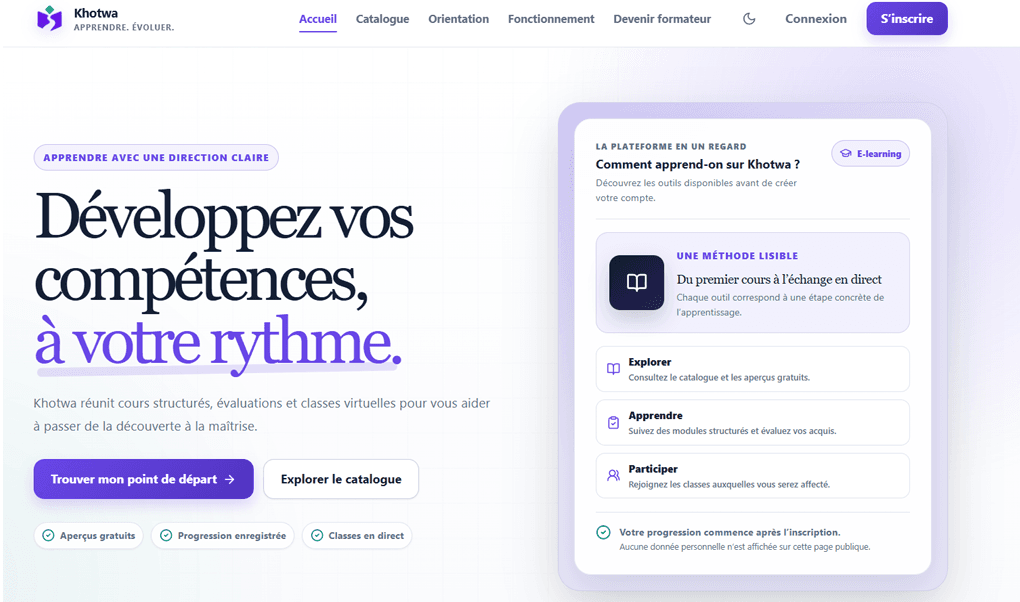
Online learning platform bringing together courses, learning paths, assessments, virtual classrooms, and learner progress tracking.
Role
Full-stack design and development during an internship at MIC Consulting Group.
Context
Developed at MIC Consulting Group, Khotwa centralizes training activities and supports learners throughout their learning journey.
Learners and trainers need a shared space to organize courses, track progress, and manage remote assessments.
Khotwa brings together Learner, Trainer, and Administrator areas, structured courses, quizzes, virtual classrooms, notifications, certificates, and a mobile app with offline access.
The platform combines a course catalog, structured lessons, resources, quizzes, progress tracking, virtual classrooms, notifications, and certificates.
A structured view of the technical blocks and responsibilities planned in the project.
Frontend
Next.js and React web app with a Flutter mobile app.
Backend
Java API built with Spring Boot, Spring Security, and Spring Data JPA.
Database
MySQL for platform data and MinIO for resource storage.
Authentication
Spring Security access control for Learner, Trainer, and Administrator roles.
Integrations
Jitsi Meet for virtual classrooms, Ollama for learning guidance, and Docker for services.
Learning paths with modules, chapters, PDF and video resources, quizzes, and progress tracking.
Dedicated learner, trainer, and administrator areas, virtual classes, and notifications.
Mobile app with offline access and an Ollama-based learning guidance assistant.
Quality is presented as a progressive engineering approach: targeted tests, readability, static analysis, and documented decisions.
The project combines a Spring Boot backend, a Next.js/React web app, a Flutter mobile app, and supporting services.
These takeaways turn the project into evidence of technical reasoning, not just a feature list.